|
|
 |
 |







 |
 |
 |
 |
 |
||
 |
 |
 |
 |
 |
 |
 |
 |
 |
 |
 |
 |
 |
|

|
||||||||||||||||||||||
|
|
|||||||||||||||||||||
|
|
|||||||||||||||||||||
|
|
|||||||||||||||||||||
|
||||||||||||||||||||||
 |
THE GREAT 2021 TICK INVASION - By Forester Russ Richardson |
| (06/10/2021) |
| photos by Forester Russ Richardson
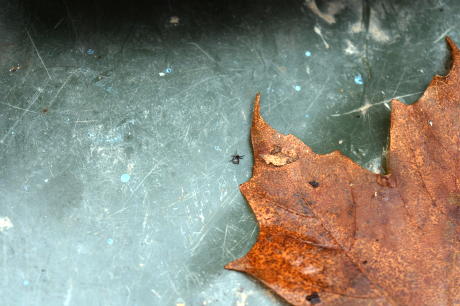
There was a time when the only thing you had to worry about in the spring was getting bitten by an American dog tick commonly known as a wood tick. In days gone by, ticks were not as common as today because frigid winter weather killed a majority of the bloodsuckers each year. The likelihood of being bitten by a tick was strictly a seasonal
concern, usually springtime. American dog ticks are easy to notice and remove because they are large (nearly the size of the button on a remote-control device) and have the habit of wandering around a body for hours, searching for a protected location to bite before settling in for a meal. Pulling off a biting dog tick off rarely results in more than a small scab that itches for a couple days. Over the past few years black-legged ticks have become extremely common in regional woodlands, especially dry oak forest and brushy old-pasture areas. Black legged ticks can carry several serious diseases especially crippling Lyme disease.
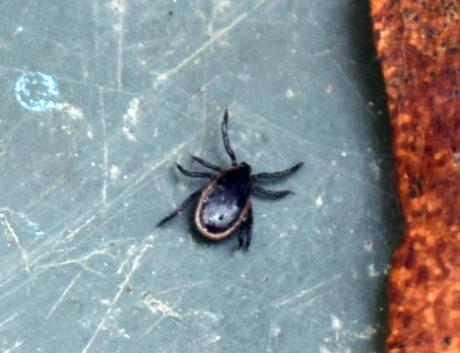
Closeup (above) of a black-legged tick next to the margin
When outside during tick season it is a good idea to make periodic tick checks throughout the day and continuously remove any ticks found on your clothing. Before getting into your vehicle after an extended time in the brush it is worthwhile doing full fledged tick check. Where Rocky Mountain spotted fever is a concern everyone often stripped down to our undershorts and checking the inside and outside of each article of clothing as we removed it. We checked our legs, groins, navels and armpits for ticks before holding our hands up like we were being robbed and having a coworker look us over more carefully.
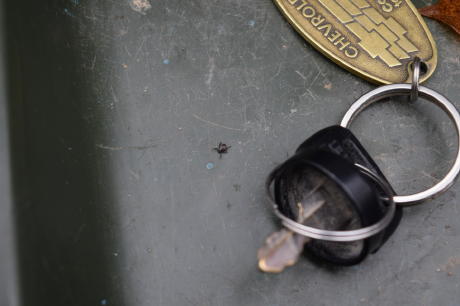 Mature black-legged ticks are tiny, less than 2 mm in diameter and extremely difficult to notice. They can bite and burrow into your skin within a couple hours of hitching a ride and leave an itchy scab any time they have even the briefest opportunity to bite. Bites from miniscule black-legged tick nymphs itch beyond description and leave a scabby lesion can take months to stop itching.
 It can often take extremely good eyesight to notice a black-legged tick on your clothing. Any unexplained and hard-to-reach persistent itch, especially on a persons sides, middle-back and shoulder blades should be looked at. Women should especially check their sides, chest and armpits. An advantage for conducting tick checks before reentering a vehicle is it reduces the chance of accidentally shedding a tick a future passenger could unknowingly pick up.
|
|
|